#89 - ICS Canada News and Views Summer 2026


What Churchill Means to Me
Following in the Footsteps of My Greatest Travel Inspiration
By Richard Shaver
July 22, 2026

I’ve been fortunate to visit 152 countries as of May 2026. People often ask what drives a lifetime of travel at that scale.
The answer doesn’t begin with a passport. A huge influence was Winston Churchill.
I was nine years old when my father brought home a commemorative record album following Churchill’s death in 1965. I played it repeatedly, drawn to a life that seemed far beyond anything I could imagine.
That early curiosity never left me. Over time, I’ve accumulated a library of nearly 150 books by or about him — and a lifelong fascination.
Churchill is widely remembered as Britain’s wartime Prime Minister. I came to know him differently: as a man shaped by travel, exposure, and an unusually global life.
Before entering Parliament, he had already served in Cuba, India, Sudan, and South Africa as both soldier and war correspondent. By his mid-twenties, he had seen conflict on three continents.
During the Second World War, he travelled nearly 100,000 miles to Washington, Moscow, Cairo, Tehran, Casablanca, and Malta — often under direct threat.
In peacetime, he remained mobile. He lectured across North America, painted in Italy, France, Switzerland, and Jamaica, with repeated trips to Marrakech, which he called “the loveliest spot in the whole world.”
Churchill didn’t travel to collect destinations. He travelled to understand them. That idea stayed with me.

Backpacking became business travel, then family journeys, then global exploration. One country became one hundred.
As my travels passed the 100-country mark and continued to grow — most recently to Mauritius, Madagascar, the Kingdom of Bhutan, the People’s Republic of Lao, Albania, and Cyprus — I often thought back to that early influence, realizing Churchill had quietly set me on this path decades earlier.
In 2010, I joined the Travelers’ Century Club after reaching more than 100 countries and territories. That same year, I founded the Canadian Chapter.
Later, I was asked to join the International Board, and in 2026 I chaired the Club’s Global Conference in Hanoi.
Over time, travel took on a second dimension: following Churchill’s footsteps wherever possible.
I’ve visited the Churchill War Rooms, Chartwell, Blenheim Palace, and his grave at Bladon. But the strongest connections often come in less expected places.

In Gibraltar, my wife Jane and I explored the wartime tunnels Churchill considered essential to Britain’s defence and visited the Barbary macaques he helped protect during the war.
Today, Winston Churchill Avenue cuts through the territory he once regarded as strategically vital.

In Malta, I stood above the Grand Harbour at Upper Barrakka Gardens, where his bronze bust faces the sea as he requested. Beneath it lies the Allied command centre that directed Mediterranean operations and planning for Sicily.

In Marrakech, the connection is more immediate.
After the 1943 Casablanca Conference, Churchill brought President Roosevelt to the La Mamounia Hotel to watch the sunset over the Atlas Mountains. Standing there years later, the view is unchanged — the same light, the same horizon, the same stillness that moved him and, in 2023, moved me.
In Brunei a few months back, I came across a dedicated Churchill museum established by the Sultan in 1971, despite Churchill never having visited the country — a reminder of how far his influence travelled beyond his physical journeys.
Whenever I stand in these places, I don’t just study history. I look for perspective.
What he saw. What he valued. What stayed with him.
Travel is not accumulation. It is perspective.
Churchill understood that instinctively. His journeys, many in Canada, shaped his writing, leadership, and worldview. Mine have shaped my understanding of a far larger world than the one I grew up in.
If I trace it back far enough, it returns to a single moment: a nine-year-old boy in Montreal listening to a record album about Winston Churchill.
Our lives were separated by generations but connected by a shared belief that the world is best understood by experiencing it directly.
That is what Winston Churchill means to me.
About Richard “Rick” Shaver

Rick Shaver, a Montreal expat now living in Toronto with his wife Jane and their family, is a Director of the International Churchill Society Canada.
Although he may claim to be semi-retired, he always seems to be involved in a project for The Hive, one of Canada’s largest marketing firms, which he co-founded in 1995.
After reading Rick’s essay on Churchill, one is not surprised that he is a member of the Travelers’ Century Club, a club exclusive to people who have travelled to 100 countries or more.
International Churchill Society Canada and Albany Club
28th Annual Dinner
June 2, 2026
Not a quote by Sir Winston, but apropos: “A picture is worth 1,000 words.”
2026 Events and the First Great Canadian Debate

To date, the International Churchill Society Canada has hosted two sold-out events in 2026.
The season launched on March 5 with “An Evening with Sir Winston,” commemorating the 80th anniversary of the “Sinews of Peace” speech. The evening featured a panel discussion between the Honourable Erin O’Toole and Robert Baines, President of NATO Canada, moderated by Dr. Andy Smith.
The momentum carried to the annual dinner at the Albany Club on June 2, where featured speaker the Honourable Bob Rae received a standing ovation.
Had the stars aligned and Erin O’Toole been available that June evening, the First (Little) Great Canadian Debate could have taken place at our head table.
As most recipients of this newsletter have attended one or both of our 2026 events, ICSC is happy to promote the inaugural First Great Canadian Debate on November 5 at the Isabel Bader Theatre.
The debate will consider the question:
Should national interest take precedence over global responsibility?
The Atlantic Charter
By Barry Davenport
With Special Contributions from PCD

Following the end of the First World War — “the war to end all wars” — the Treaty of Versailles in 1919 established the League of Nations, an intergovernmental treaty whose objectives were to promote global disarmament and, through behavioural rules, prevent future global conflicts.
Although championed by U.S. President Woodrow Wilson, the United States never joined the League, although notably both Germany and Japan did.
Geopolitical instability resulted in storm clouds that became more and more evident in the early 1930s, when Nazi Germany withdrew from the League in 1933 and, unopposed, remilitarized the Rhineland in 1936.
Following the German invasion of Poland on September 1, 1939, Britain declared war on Germany two days later, and Canada declared war on September 10.
As hostilities grew, the United Kingdom was experiencing an existential threat, as evidenced by the Dunkirk troop evacuation in 1940. A German invasion was only narrowly thwarted by the heroism of Allied pilots who fought in the Battle of Britain from July through October 1940.
With this backdrop, Winston Churchill was appointed Prime Minister of the War Cabinet on May 10, 1940. His immediate priority was to organize the defences of the United Kingdom and its allies in what seemed, at the time, to be an impossible task.

This was clearly evident to U.S. President Franklin Delano Roosevelt when, in 1941, Churchill communicated a desperate need for assistance to prevent the collapse of Great Britain.
Roosevelt was under pressure to keep the United States out of “another European war.” He required proof of Churchill’s resolution to continue to fight and absolute backing from the population to see him as their leader.
FDR also had misgivings about Churchill’s reputation as a prolific consumer of alcohol. With this in mind, the President dispatched his key adviser, Harry Hopkins, to visit Josef Stalin in Moscow and then continue to London to meet with Churchill.
Hopkins returned to Washington with a positive view of Churchill and his perceived commitment of the British people to “fight to the death.”
Recognizing that a British collapse exposed the United States to the possibility of a direct invasion, Roosevelt proposed a secret meeting in August 1941 in “some lonely cove” along the remote East Coast of North America to consider a joint strategy.
The meeting site identified was off the island of Newfoundland, then a British Dominion — Newfoundland joined Canadian Confederation on March 31, 1949 — near the village of Ship Harbour in Placentia Bay.
The village was close to the large American naval base at Argentia, where one of FDR’s sons was stationed. FDR was also familiar with the area because he had previously visited to fish for salmon.

Without the required clearance from the U.S. government, FDR secretly sailed in his yacht, the USS Potomac, which was escorted by three destroyers, to meet the presidential naval cruiser USS Augusta, which then transported him to the Ship Harbour meeting.
Churchill travelled by train with his entourage to the United Kingdom’s principal naval base, Scapa Flow, in Scotland. There he boarded HMS Prince of Wales, the largest and most modern battleship in the British fleet, supported by a crew of 1,500.
Arriving on Saturday, August 9, 1941, and accompanied by a contingent of senior British military leaders, they anchored amidst approximately 24 American and British naval warships.
Churchill was then ferried to the USS Augusta, where he met FDR, delivering a personal letter from King George VI. Churchill stated that it was a pleasure to meet for the first time.
The President embarrassed the Prime Minister by reminding him that they had previously met in 1919 at the Versailles Conference, at which time FDR was a junior ensign.
Over the next few days, meetings and discussions were held, inspired by their belief that it was essential to give sound reasons to justify countries engaging in armed combat.
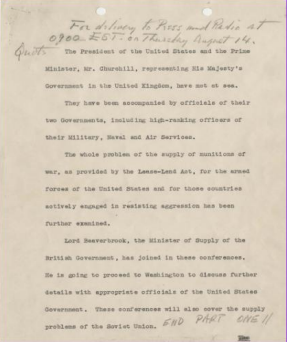
On August 14, they released a document entitled “The Atlantic Charter,” which consisted of eight common principles embodying their hopes for a “better future of the world.”
The Eight Principles of the Atlantic Charter
First, that their countries seek no aggrandizement, territorial or other.
Second, they desire to see no territorial changes that do not accord with the freely expressed wishes of the peoples concerned.
Third, they respect the right of all peoples to choose the form of government under which they will live, and they wish to see sovereign rights and self-government restored to those who have been forcibly deprived of them.
Fourth, they will endeavour, with due respect for their existing obligations, to further the enjoyment by all states — great or small, victor or vanquished — of access, on equal terms, to the trade and to the raw materials of the world which are needed for their economic prosperity.
Fifth, they desire to bring about the fullest collaboration between all nations in the economic field, with the object of securing, for all, improved labour standards, economic advancement, and social security.
Sixth, after the final destruction of Nazi tyranny, they hope to see established a peace which will afford to all nations the means of dwelling in safety within their own boundaries, and which will afford assurance that all people in all lands may live out their lives in freedom from fear and want.
Seventh, such a peace should enable all people to traverse the high seas and oceans without hindrance.

Eighth, they believe that all the nations of the world, for realistic as well as spiritual reasons, must come to the abandonment of the use of force.
Since no future peace can be maintained if land, sea, or air armaments continue to be employed by nations that threaten, or may threaten, aggression outside their frontiers, they believe, pending the establishment of a wider and permanent system of general security, that the disarmament of such nations is essential.
They will likewise aid and encourage all other practicable measures that will lighten for peace-loving peoples the crushing burden of armaments.
In keeping with this document, the two leaders expressed the wish “to see sovereign rights and self-government restored to those who have been forcibly deprived of them.”
The Aftermath
Upon the completion of the meetings on August 14, 1941, the President and Prime Minister returned home. The document was tabled with their respective governments, an endeavour they anticipated would be incorporated into each country’s foreign policy.
However, their attempts did not receive the reception they anticipated.
The U.S. Congress was reluctant to do anything that might support the continuity of the British Empire and its “Imperial Preference” tariff structure. Public opinion at the time was isolationist and opposed to military intervention.
The UK government feared that the document’s focus on self-determination could possibly contribute to the demise of the British Empire.
While the meeting was successful in drafting these aims, it failed to produce the desired results for either leader.
President Roosevelt had hoped that the Charter might encourage the American people to back U.S. intervention in the Second World War on behalf of the Allies. However, public opinion remained adamantly opposed to such a policy until the Japanese attack on Pearl Harbor on December 7, 1941.
Churchill’s primary goal in attending the meeting was “to get the Americans into the war.” Barring that, he hoped that the United States would increase its amount of military aid to Great Britain and warn Japan against taking any aggressive actions in the Pacific.
Roosevelt, on the other hand, wanted the British Government to affirm publicly that it was not involved in any secret treaties, particularly ones concerning territorial questions, such as those concluded by the Allies during the First World War concerning the division of enemy territory at war’s end.
Roosevelt also wished to arrange the terms by which Great Britain would repay the United States for its Lend-Lease assistance. Roosevelt wanted the British to pay compensation by dismantling their tariff system of Imperial Preference.
Churchill was extremely disappointed by Roosevelt’s refusal to discuss American entry into the war.
Furthermore, Churchill understood that several aspects of the proposed joint declaration might be politically damaging.
Churchill worried that the abandonment of Imperial Preference tariffs would anger the protectionist wing of his Conservative Party.
The Americans also proved unwilling to warn Japan too strongly against any future military action against British possessions in Southeast Asia.
Finally, both Churchill and many members of his Cabinet were alarmed by the third point of the Charter, which mentions the rights of all peoples to choose their own government. Churchill was concerned that this clause acknowledged the right of colonial subjects to agitate for decolonization, including those in the British Empire, especially India.
Nevertheless, Churchill realized that the joint declaration was the most he could accomplish during the conference.
While the United States would remain neutral, the declaration would raise the morale of the British public and, most importantly, bind the United States closer to Great Britain.
Therefore, when Churchill forwarded the text of the declaration to his Cabinet on August 11, he warned them that it would be “imprudent” to raise unnecessary difficulties. The Cabinet followed Churchill’s recommendation and approved the Charter.
While the Atlantic Charter of August 1941 was not a binding treaty, it was nonetheless significant for several reasons.
First, it publicly affirmed the sense of solidarity between the United States and Great Britain against Axis aggression.
Second, it laid out President Roosevelt’s Wilsonian vision for the postwar world: one that would be characterized by freer exchanges of trade, self-determination, disarmament, and collective security.
Finally, the Charter ultimately did serve as an inspiration for colonial subjects throughout the Third World.
At the meeting of the Inter-Allied Council in London on September 24, 1941, the governments in exile of Belgium, Czechoslovakia, Greece, Luxembourg, the Netherlands, Norway, Poland, and Yugoslavia, together with the Soviet Union and representatives of the Free French Forces, unanimously adopted adherence to the common principles of policy set forth.

On January 1, a larger group of nations that adhered to the Charter’s principles issued a “Declaration by United Nations.”
The Charter is now recognized as the catalyst that led to the formation of NATO in 1949.
The commemoration of this historic meeting first took place in Ship Harbour in 1991.
More recently, in 2011, 2016, and again in 2021, the International Churchill Society Canada, the NATO Association of Canada, the Churchill Society for the Advancement of Parliamentary Democracy, and the Crow’s Nest Officers Club organized events in Ship Harbour, St. John’s, and Placentia.
This was initially inspired by the encouragement and support of the Lieutenant Governor of Newfoundland and Labrador, the Honourable John C. Crosbie, OC, and under the direction of Peter Russell, OC.
About Barry Davenport

Barry Davenport, a longtime friend and supporter of the International Churchill Society Canada, is a founding member of the Atlantic Charter Committee, a past President of the St. George’s Society of Toronto, and a recipient of the Queen Elizabeth Golden and Diamond Jubilee Medals.
He lives in Toronto and Collingwood with his wife, Patricia Carroll.
Read the Original Atlantic Charter

The original script of the document, released to the press at 9:00 AM EST on August 14, 1941, is presently housed at the FDR Library.
Atlantic Charter Day

August 14, 2021
Commemoration: Mysterious Visitors