
#88 - ICS Canada News and Views Spring 2026

28th Annual Joint Dinner

The International Churchill Society Canada and the Albany Club of Toronto are pleased to invite members, friends, and supporters to join us at our 28th annual joint dinner, to be held on June 2.
The Honourable Bob Rae, a distinguished Canadian statesman, diplomat, and lawyer, has served at the highest levels of the Canadian government and international affairs. He recently concluded a landmark term as Canada’s Ambassador to the United Nations from 2020 to 2025. He was also Interim Leader of the Federal Liberal Party from 2011 to 2013 and Premier of Ontario from 1990 to 1995.
Cocktails (Cash Bar): 6:00 PM — SJA Lounge, 4th Floor
Dinner: 7:15 PM — Main Dining Room
Location: Albany Club, 91 King Street East, TorontoTelephone: 416-364-5471
Price: $200 for Members, Subscribers, and Guests
Dress Code: Business Attire
Payment Options
Credit/Debit Card through PayPal:https://www.paypal.com/ncp/payment/M5YQRAM4NMDJC
Or by e-transfer:
Payee Name: ICS Canada
Why Churchill Matters (To Me Today)
By Terry Reardon, Vice Chairman, International Churchill Society Canada

It would be expected that someone born at the time of the Second World War, with formative years in the 1950s, would have held Churchill in high esteem.
However, my interest in the War and the aftermath was directed to the films depicting events such as The Dam Busters and The Man Who Never Was. My heroes were depicted by actors such as John Mills and Kenneth More.
It was when I emigrated to Canada that my interest in the real hero of the War was piqued. The CBC radio broadcast documentaries on Saturday mornings included a series on Winston Churchill, including his wartime speeches.

I purchased his “History” of the war and then the volumes of his prewar exhortations. The first covered the period from March 13, 1936, to March 15, 1939, and the book was titled Step by Step. As he wrote in the preface, “I have not omitted a single letter, nor have I altered what was written at the time.”
So why was Churchill so very, very right; and why were Chamberlain, Baldwin, et al. so very, very wrong?
“Study history, study history. In history lie all the secrets of statecraft,” Churchill said in 1953. He was a student of history and was able to interpret the actions and intentions of Adolf Hitler.
An illustration of this was Churchill’s reaction to the Munich Agreement of September 1938, by which the Sudetenland area of Czechoslovakia was handed over to the Nazis, and Germany and Britain pledged never to go to war against each other again.

Churchill spoke in the House of Commons on October 5, 1938. This consumes sixteen pages of the volume of his speeches entitled Blood, Sweat and Tears in Canada, and Into Battle in Britain.
This included:
“I will begin by saying what everybody would like to ignore or forget but which must nevertheless be stated: that we have sustained a total and unmitigated defeat… I think that in a period of time, which may be measured only by months, Czechoslovakia will be engulfed in the Nazi regime.”
This was borne out when, in March 1939, German troops took over the rest of that country.
When war was declared in September 1939, Prime Minister Neville Chamberlain asked Churchill to join the Government. The reaction of many would have been to tell Chamberlain to “stew in his own juice,” but that was not Winston Churchill, and he threw himself into his responsibilities as First Lord of the Admiralty.
My Churchill journey continued by way of musty, dusty, second-hand bookshops, and I augmented my Churchill collection until I had all fifty volumes written by the Great Man.
One is Great Contemporaries, published in 1937. This includes chapters on twenty-one diverse characters such as Hindenburg, Lawrence of Arabia, and Leon Trotsky — as well as Adolf Hitler, with the annotation that this chapter was written in 1935.
The chapter included:
“We cannot tell today whether Hitler will be the man who will once again let loose upon the world another war in which civilization will irretrievably succumb…. Only time can show, but, meanwhile, the great wheels revolve; the rifles, the cannon, the tanks, the shot and shell, the air-bombs, the poison-gas cylinders, the aeroplanes, the submarines, and now the beginnings of a fleet flow in ever-broadening streams from the already largely war-mobilized arsenals and factories in Germany.”
Churchill mattered in 1935, but no one in authority listened.
As his daughter, Lady Mary Soames, often stated, people should not opine on what her father would do if faced with current problems in the world. However, it would be interesting to ponder his possible reaction to the war in Ukraine — would he be content with furnishing weapons to Ukraine to fight alone, while Canada and the other NATO countries continue to have diplomatic relations with the Soviet Union?
Churchill’s lessons are as relevant today as they were in the 1930s.
Terry Reardon and Steve Paikin

Terry Reardon and Steve Paikin discuss Terry’s book, Winston Churchill and Mackenzie King: So Similar, So Different.
Evening with Sir Winston
March 5, 2026 — 80th Anniversary of Sir Winston Churchill’s “Sinews of Peace” Speech
Panel discussion between the Honourable Erin O’Toole and Robert Baines, President of NAOC (NATO Association of Canada), moderated by Dr. Andy Smith.
How does one judge the success of an event? Is it by the tickets sold, or by the “lingering factor” — those who remain afterward to chat, discuss, and/or dissect the tone of the evening?
ICS Canada’s first function of 2026 was held at the Albany Club to a sold-out, standing-room-only audience.
Once the formal Q&A ended and the microphones were laid to rest, in what was apparently an effort to prolong the tone of the evening, so many of our guests stayed.
They mingled with each other, consumed what was left of the buffet, and continued a dialogue with Erin and Robert, who graciously engaged.
Honouring Historical Figures of Valour
“Churchillian” Evan Kantel Wins Award from International Churchill Society Canada

“There were several times during his life when he could have given up, whether it be after his dismissal during the First World War, his lost years in the ’30s, or the beginning of the Second World War,” says Evan.
“Instead, he persevered, and during World War II refused to surrender even when the situation seemed hopeless. I think this is something we can learn from: not to surrender to evil, regardless of the circumstances.”
— Evan Kantel
Paying Homage to the Roaring Lion

Château Laurier, Ottawa, Ontario
Paying homage to the “Roaring Lion,” Sir Winston Churchill.
Ann Taillon, Friend and Supporter of ICS Canada.
Pestana Churchill Bay Hotel, Madeira, Spain
Susan Mackle, CSAPD Director and an ICS Canada friend and supporter.


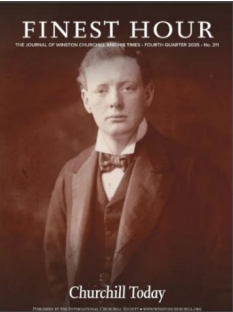
Finest Hour #211: Churchill Today
The most recent issue of Finest Hour is No. 211, Churchill Today.

A New Generation of Historian

“My recent master’s thesis on Winston Churchill and Total War was published in the International Churchill Society’s latest edition of its Finest Hour journal! And how fitting that I received my copy in the same week as the 80th anniversary of the Sinews of Peace speech!”
— Oliver Groom
David Frum and Lord Andrew Roberts
David Frum and historian and journalist Lord Andrew Roberts discuss why right-wing podcasters seem so fixated on insisting that Winston Churchill was the villain of the Second World War. They also discuss the origins of pseudo-historians and why they appeal so much to the American right.
Related Reading: Why the Far-Right Hates Churchill
By Andrew Roberts

The accepted historical narrative of the past 80 years — that it was morally right for the United States and the United Kingdom to fight and destroy the Third Reich — is now under assault.
A Prelude to Immortality

Winston Churchill’s My Early Life — Gary L. Stiles
Andrew Roberts: “Fascinating biography of a biography.”
Katherine Carter: “A superb study of Churchill the writer.”
Allen Packwood: “A well-crafted and lavishly illustrated deep dive into Churchill’s most revealing book.”
David Freeman: “Stiles has produced an encyclopedic study of Winston Churchill’s most beloved book.”

Lecture: Gary Stiles
Gary Stiles presents “New Discoveries about Winston Churchill’s Autobiography” at the Grolier Club.

The Hub Canada Dialogues
Historian warns Hitler sympathizers are rewriting WWII history — and winning.
Predicting the Storm: Churchill in the 1930s
Michael Carin

During six pivotal years in the 1930s, Winston Churchill’s speeches stood against the tide of public opinion, put him at odds with his own party, and regularly drew hisses and catcalls in the House of Commons. Yet his solitary voice, armed with principle and prescience, forged a lesson in history which never fails to fascinate.
Churchill’s first substantial warning of the Nazi menace came three weeks after Adolf Hitler was appointed Chancellor of Germany, and four days after the Reichstag fire.
It was a Thursday in late February of 1933 when he rose in the House of Commons and spoke of the “grim and bitter” mindset of the Nazi regime and the “warlike spirit” being propagated throughout Germany.
In his view, it was vital for people to see that “tremendous and measureless ambitions” were being unleashed.
Together with the Nazi drive for rearmament, he predicted, the rising fervour in Germany was making the country a direct threat to the peace of Europe.
Even from our distance of over ninety years, the significance of that speech retains its remarkable gleam and acumen.
The Nazi regime was in its infancy, and most of the world regarded it as another transient German government. Hitler himself was widely belittled as a passing demagogue, likely to be deposed. Hence the strategic foresight of Winston Churchill.
His speech was extraordinary for the extent of its prophecy. His views were not based on the easy sagacity of hindsight, but on the perceptive judgment of a mind that had studied the valleys of history and understood the depths to which human folly could plunge the world.
Churchill perceived the events in Germany as the initial vibrations of a coming earthquake.
The prophet, however, won no praise. Rather the opposite. His speech marked the moment when the canary in the coal mine shrilled out, only to be told it was making unwelcome noise.
Churchill’s warning was answered with official disavowal and public derision. His reputation, already battered, suffered a fresh beating.
Cartoons in the press drew him as a cantankerous has-been, an old reactionary out of touch with the era’s abhorrence of the very idea of another world conflict. The prevailing ethos in the country was one of stubborn dedication to peace.
Still, despite the calumnies and almost universal censure he suffered, the bulldog in Churchill persevered.
As the decade wore on, undeterred by the heckles which regularly greeted his speeches, Churchill’s analyses grew more meticulous and urgent. His lone battle in the Commons evolved into a detailed exposure of Germany’s secret, and eventually overt, program of rearmament.
Drawing on information brought to him by a network of contacts within the military and civil service, his speeches came thick with alarming figures. He cited Germany’s immense military budget.
He revealed the extent of the Wehrmacht’s training of an army which blatantly violated treaty obligations. He pointed repeatedly to the ever-expanding size and power of Hitler’s air force.
With uncanny insight, he painted air power as the key element of modern warfare and identified the growing bomber fleet of the Luftwaffe as an existential threat to Britain.
To grasp the historic import of Churchill’s campaign, we must appreciate how profoundly exiled he was during the 1930s. He was a political orphan, operating outside the circle of influence within his own Conservative Party.
With no official post, effectively a backbencher, he was, in the parlance of the time, “in the wilderness.” Despite the weight of his evidence and the genius of his oratory, he remained the bête noire of his supposed colleagues, who refused him any impact on policy.
The government, led first by Ramsay MacDonald, then by Stanley Baldwin, and then, most catastrophically, by Neville Chamberlain, consistently worked to portray Churchill’s claims as warmongering exaggerations.
The policy of the government was engagement, not confrontation. The result was episode of appeasement after episode of appeasement.
Meanwhile, the Labour opposition, steeped in pacifism, saw Churchill’s words as inflammatory and characterized his warnings as an attempt to justify a new, expensive arms race.
Thus, the man who saw the gravest danger with the most precision was the man whom the political establishment was least willing to hear.
In 1938, when Chamberlain returned from Munich waving a piece of paper and proclaiming “peace for our time,” Churchill labeled the agreement reached with Hitler “a total and unmitigated defeat.”
He argued that the Munich settlement had not averted war but only postponed it on far more dangerous terms.
He was then shouted down in Parliament and vilified in the country at large. His reputation fell to its lowest ebb, just as all his predictions were approaching their terrible realization.
In 1939, following six grim, disgraceful, squandered years, Germany invaded Poland, and the British people finally accepted that Churchill had been right all along.
Winston Churchill’s stance during the 1930s remains modern history’s supreme example of choosing a difficult right over a popular wrong.
He established an eternal precedent in the annals of statecraft: true leadership requires the audacity to be contrary, even when one’s voice is met by the jeers of the crowd.
The great man’s ultimate vindication represents a legacy not merely to be forever recalled, but to be emulated when the necessity arises for moral clarity and the courage to champion it.
About Michael Carin
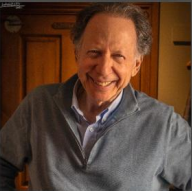
Michael Carin is a Montreal-based author who trained as a political theorist at McGill University, where he also studied under the godfather of Canadian literature, Hugh MacLennan.
He was Editor-in-Chief of Montreal Business Magazine, an inset in the Quebec issue of The Globe and Mail, for many years. He is the author of several novels, including Five Hundred Keys, The Kremlin Papers, and the work of alternate history Churchill at Munich.
His most recent novel is the Guernica Prize winner, Edisson and Jeremiah.
Supplemental Reading
Winston Churchill in Political Cartoons
On Germany’s Rearmament
HC Deb 12 November 1936, vol. 317, cc1081–155